The Differences Between Trademarks, Patents, Copyrights, and Trade Secrets
Trademarks, patents, copyrights, and trade secrets the four core pillars of intellectual property (IP). Each offers distinct protections, serves different purposes, and follows unique legal rules.
1. Trademark
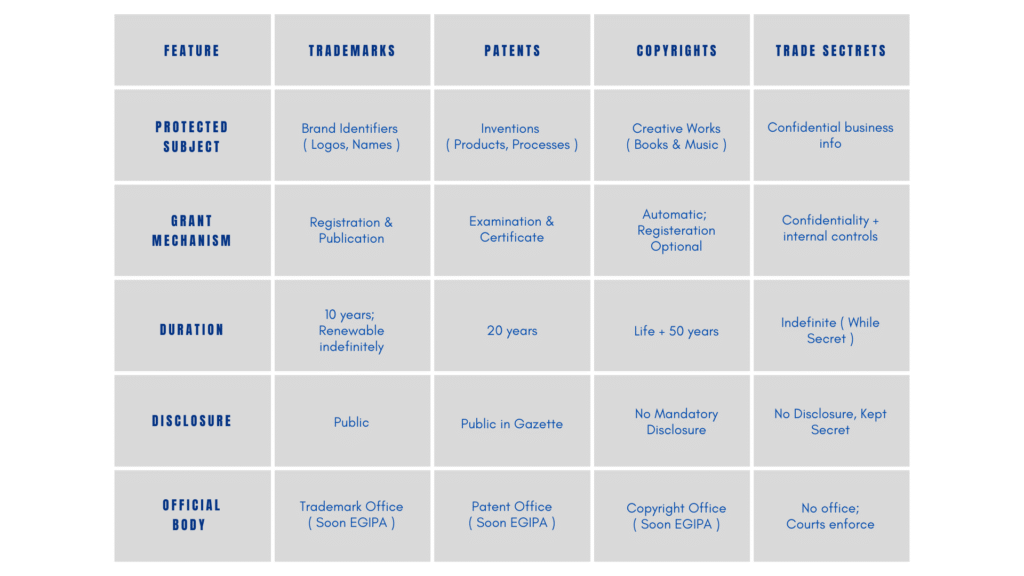
It protects Words, names, logos, slogans, symbols, colors, sounds or even packaging shapes that identify and distinguish the source of goods/services.
Purpose: Helps consumers identify and trust brands; prevents others from using confusingly similar marks.
Duration: Initial 10‑year term from registration; renewable indefinitely in 10‑year increments.
Registration: Not required but highly beneficial. It signals public notice, creates a legal presumption of ownership, and grants stronger enforcement rights.
2. Patent
it protects new, useful, and non-obvious inventions ranging from machines and processes to chemical compositions and improvements.
Exclusions: Discoveries, scientific theories, mathematical methods, computer programs, surgical methods, biological materials (e.g., plants, animals), organs, nuclei acids and genomes
Rights granted: The government gives an exclusive right to exclude others from making, using, selling, offering to sell, or importing the invention for a limited time.
Term: 20 years from the filing date; subject to annual renewal fees.
3. Copyright
It guards original expressions like books, music, movies, software code, photos, choreography, and more once fixed in a tangible form. Notably, ideas, facts, procedures or processes aren’t shielded only the specific expression is:
Exclusive rights: The author holds rights to reproduce, distribute, create derivatives, publicly display, and perform the work.
Duration: In Egypt: Life of the author + 50 years (related rights vary).
4. Trade Secret
It protects typically confidential business information, formulas, methods, designs, customer lists, “know‑how” hat provides economic value by being secret.
Duration: Indefinite as long as kept secret.
–Menna Amr – Sep.2025

Get in Touch
Let’s Protect Your Ideas